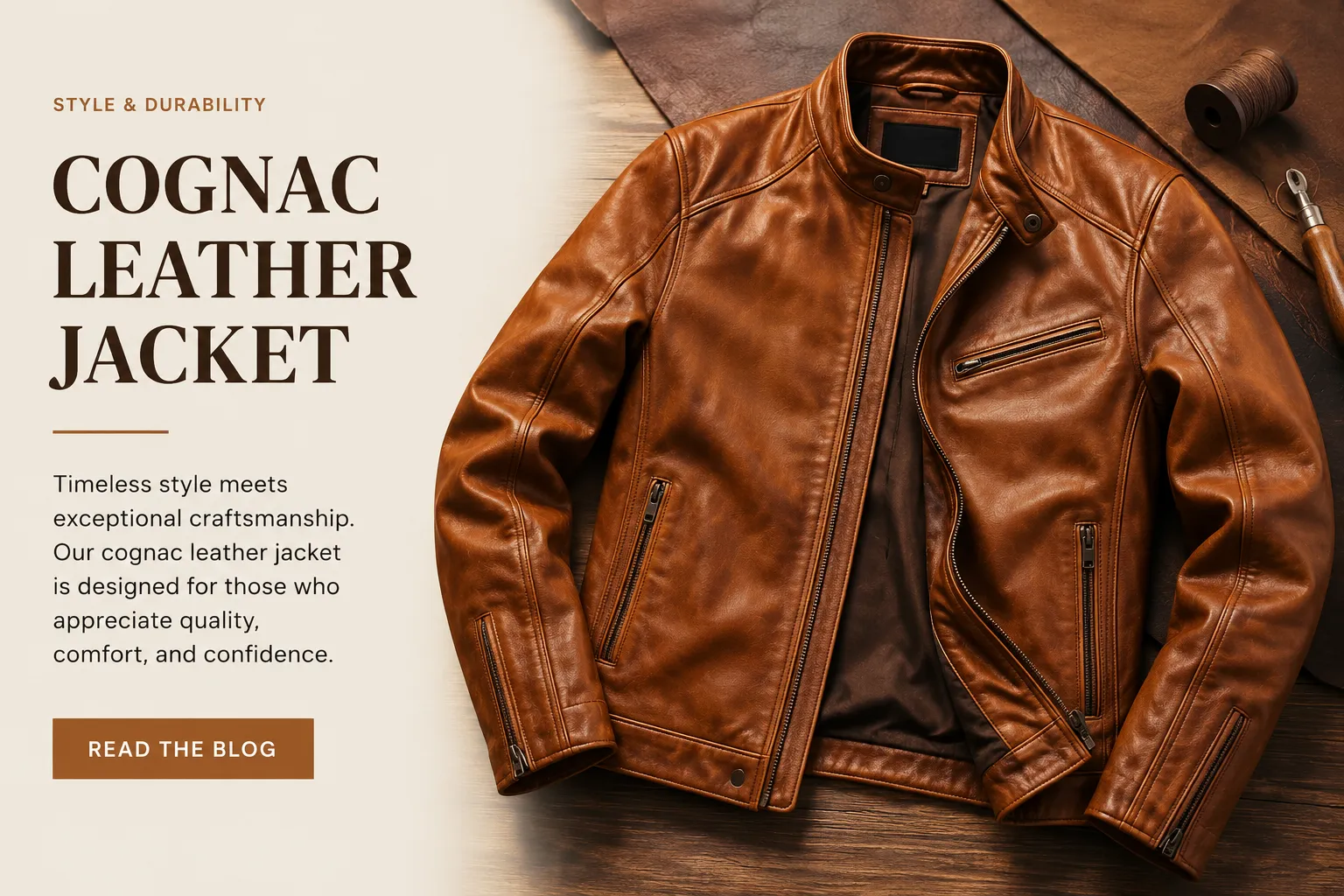
Most men own a black leather jacket. Far fewer own a cognac one. That's the point.
A cognac leather jacket does something black cannot — it reads as simultaneously rugged and refined, urban and unhurried. It carries the warmth of amber, the richness of aged brandy barrels, and the understated certainty of a man who understands that restraint is its own form of authority. Belstaff built a century of heritage around this understanding. The American pilots who wore A-2 flight jackets across the Pacific grasped it intuitively. This is not a seasonal trend. It is an archetype.
The problem is that the market is thick with cognac jackets that photograph beautifully and disappoint bitterly. The leather is corrected-grain. The dye is sprayed on. The patina never comes, because there is no depth to draw from. Choosing correctly requires knowing precisely what you're looking at — and what to walk away from.
This guide covers everything that actually matters: how the cognac tone is produced, why certain grades outperform others across decades, how to build outfits that work rather than merely coordinate, and how to maintain the jacket so it becomes better with every year you carry it.
Table of Contents
- What Makes Cognac Leather Different from Other Shades
- How the Cognac Tone Is Achieved Through Vegetable Tanning
- Full-Grain vs. Top-Grain vs. Corrected-Grain: What to Buy and What to Avoid
- How to Style a Cognac Leather Jacket: Four Expert Formulas
- Colour Pairing: What Works, What Doesn't, and Why
- Cognac vs. Tan vs. Brown vs. Whiskey: Understanding the Spectrum
- Seasonal Wear: When and How Cognac Performs Best
- How to Care for Cognac Leather the Right Way
- Common Mistakes When Buying a Cognac Leather Jacket
- What to Examine Before You Purchase
- Frequently Asked Questions
What Makes Cognac Leather Different from Other Shades
Black leather absorbs. Cognac reflects.
That is not poetic overstatement — it describes a literal optical quality. Black leather flattens ambient light and merges with whatever environment surrounds it. A cognac jacket, particularly one made from vegetable-tanned full-grain calfskin, shifts with the light. In direct afternoon sun, it glows amber. Under evening indoor lighting, it deepens to burnished bronze. In overcast grey northern light, it reads warm and deliberate against the surroundings.
This tonal behaviour comes from the leather itself, not from surface treatment. It requires a hide with an open, unaltered grain surface — one that reflects light from the fibre level rather than from a coating applied over the top. This is why the material grade and tanning method determine whether a cognac jacket has genuine depth or simply appears brown.
Cognac also occupies the most socially versatile position in the leather spectrum. It is neither the stark formality of black nor the demanding casualness of pale tan. It works with tailoring, denim, knitwear, and work clothing without effort. This versatility is one of the few claims in men's style that survives contact with reality.
How the Cognac Tone Is Achieved Through Vegetable Tanning
The name derives directly from the French brandy region, which borrows its characteristic colour from the oak barrels in which the spirit ages. In premium leather production, a genuine cognac tone is not sprayed on. It develops through a specific combination of tanning method and natural dye application.
The Vegetable Tanning Foundation
At Tuxar, we specify full-grain Italian calfskin that is vegetable-tanned using chestnut and oak bark extracts — a process that takes between 40 and 60 days. Natural tannins drawn from these plant sources penetrate the cellular structure of the hide at depth. The result is leather that is dense, breathable, and structurally alive to its environment in a way that chrome-tanned alternatives are not.
Why Natural Dyeing Produces Depth
The dye applied to vegetable-tanned leather penetrates rather than coats. Because the hide's grain surface remains unaltered — not buffed, sanded, or filled — the dye settles into the natural topography of the hide. Raised areas hold slightly less colour; recessed areas deepen. The result is a tonal variation that you can see shift depending on the angle and quality of the light. This variation is not inconsistency. It is the visual evidence that nothing artificial is concealing the leather beneath.
Chrome-tanned cognac leather looks uniform. Because it often carries a surface coating, the light bounces off flatly. It registers as a single-note brown rather than the layered amber of genuine vegetable-tanned material. This difference becomes obvious in person and photographically invisible — which is precisely why online purchases of leather goods require research rather than instinct.
Expert Tip: When examining a cognac leather jacket in person, tilt it slightly under a directional light source. Genuine vegetable-tanned full-grain leather will show a subtle shift from lighter to deeper tones across the surface. Corrected or chrome-tanned leather will remain completely uniform regardless of angle.
Full-Grain vs. Top-Grain vs. Corrected-Grain: What to Buy and What to Avoid
The leather grade matters more than the brand name. Here is a direct comparison of the four grades you will encounter.
| Grade | Surface Treatment | Patina Development | Durability | Initial Feel | Worth Buying? |
|---|---|---|---|---|---|
| Full-grain | None — natural outer surface | Outstanding | Exceptional | Structured, breaks in over time | Yes |
| Top-grain | Light sanding, minor correction | Minimal | Good | Immediately supple | Conditionally |
| Corrected-grain | Heavy buffing and embossing | None | Moderate | Artificially soft | No |
| Bonded leather | Composite from offcuts | None — peels | Poor | Thin, plasticky | Never |
For a cognac jacket intended to last decades, full-grain is the only grade worth considering. The reasoning is structural: cognac leather's most valuable quality is its patina — the way it deepens and individualises over years of wear. Full-grain is the only grade whose surface is capable of developing patina, because it retains the unaltered fibre structure that responds to oils, friction, and sunlight. Every other grade either lacks that structure entirely or has had it removed.
Our Monaco Calfskin Racer is built from 1.2mm full-grain Italian calfskin selected for tight grain uniformity and appropriate weight for a structured jacket silhouette.
How to Style a Cognac Leather Jacket: Four Expert Formulas
Cognac works because its undertones are neither exclusively warm nor exclusively cool — they shift depending on what you pair it with. This gives it genuine versatility, but it also means that some combinations work and others actively compete. Here are four approaches that consistently succeed.
1. The Heritage Café Racer
Pair a slim, band-collar racer jacket with a heavyweight cream crewneck knit, raw indigo selvedge denim, and dark brown leather Chelsea boots. The warmth of the cream against the amber jacket creates an analogue harmony — a palette built entirely from the same end of the colour wheel, with contrast delivered by texture rather than hue. Add a vegetable-tanned holdall like the Weekender 48 Cognac and the leather registers as a considered system rather than a coincidence.
This combination works in autumn and winter in any urban context from London to Toronto to Berlin. It requires no visible effort to maintain, which is the defining quality of a good outfit.
2. The Contemporary Minimalist
Wear the jacket over a fitted charcoal or slate turtleneck, tailored black trousers with a slight taper, and black suede Chelsea or Derby boots. The dark base pulls the cognac forward as the outfit's single warm focal point. Nothing competes with it. This approach works best with a shorter-cut jacket — one that ends at the hip or slightly above — because the proportions balance cleanly against the dark trousers.
Do not add a patterned shirt or competing accessories. The jacket earns its place by standing alone.
3. The Weekend Rider
If you ride, you already understand the visual relationship between cognac leather and the road. A flight jacket or bomber silhouette in cognac over washed grey jeans, a clean white t-shirt, and brown Goodyear-welted boots reads as entirely uncontrived — because it is. The colour coordinates with classic motorcycle aesthetics authentically, without any effort to costume.
4. The Smart Casual Layer
Over a pale blue or white Oxford button-down, tucked into slim khaki or olive chinos, with brown leather loafers, a cognac jacket transitions the outfit from relaxed to considered. This works particularly well in transitional seasons — the jacket adds weight and colour to an otherwise light palette. The combination reads as intentional in most contemporary workplace contexts and almost any social setting.
Colour Pairing: What Works, What Doesn't, and Why
| Pairs Well With | Why It Works | Avoid | Why It Fails |
|---|---|---|---|
| Cream, ivory, off-white | Warm harmony, tonal family | Bright orange or red | Too much warmth, chaotic |
| Charcoal grey, slate | Cool contrast frames the warmth | Yellow, mustard | Colour temperature conflict |
| Raw indigo, mid-wash denim | Classic contrast, masculine | Bright white | Too stark, breaks the warmth |
| Olive green, forest green | Earth tone alignment | Browns too close in hue | Muddy, no contrast |
| Navy blue | Sharp contrast, timeless pairing | Bold graphic prints | Compete with the jacket |
| Deep burgundy | Jewel-tone depth | Light pink | Reads too soft against cognac |
Cognac vs. Tan vs. Brown vs. Whiskey: Understanding the Spectrum
These four terms are frequently used interchangeably in product descriptions. They should not be.
Tan sits at the lightest end of the brown leather spectrum. It is pale, sandy, and close to the raw hide before significant dyeing. Tan leather shows every mark immediately, darkens fastest with wear, and requires more maintenance discipline. It is unforgiving in daily use but spectacular when it ages well.
Cognac occupies the mid-range — darker and richer than tan, warmer and more amber than standard brown. It has been dyed to a deeper amber-brown while retaining visible warmth in its undertones. It is more forgiving on daily marks than tan while still developing a pronounced, desirable patina.
Whiskey is largely a marketing term used to describe a shade very similar to cognac, perhaps leaning slightly redder or darker. The practical difference between cognac and whiskey is minimal; what matters far more is the leather grade and tanning method.
Brown covers a broad spectrum from medium walnut to dark espresso. Dark brown reads more formal and cooler in tone than cognac — it pairs more naturally with tailoring and smart-casual outfits.
For maximum versatility across both casual and smart settings in most climates, cognac is the pragmatic choice among the four.
Seasonal Wear: When and How Cognac Performs Best
Autumn (September to November)
Cognac's optimal season. The jacket's amber tones mirror the environment directly — the warm palette reinforces rather than interrupts what surrounds it. Layer over lightweight merino in early autumn and heavier wool knits as temperatures drop. The jacket begins to perform as an outer layer down to approximately 8–10°C with appropriate layering.
Winter (December to February)
A leather jacket is not a winter coat in northern climates. However, it functions well as a substantial mid-layer — worn over a heavy flannel shirt or beneath a wool overcoat, it creates a genuinely warm system while appearing deliberately composed at the collar and cuffs where it shows. In milder coastal climates (southern UK, California, Mediterranean Europe), it carries as a primary outer layer through most of winter.
Spring (March to May)
As temperatures rise, the jacket functions as a standalone outer layer again. Spring is also the most visually interesting season for cognac — morning light brings out amber warmth, afternoon sun deepens it toward honey, and evening light shifts it toward bronze. The jacket earns its keep across the day.
Summer (June to August)
In northern Europe and Canada, summer evenings frequently justify a leather jacket. UK summer nights in particular are reliably cool enough for one. In warmer climates, summer wear is limited to cool evenings or air-conditioned environments.
How to Care for Cognac Leather the Right Way
Cognac leather requires more deliberate care than darker shades — a mark that disappears into black shows clearly on amber. This is not a weakness; it is why cognac jackets develop such distinctive individual character. But it demands consistency.
Cleaning
For surface dust and general dirt, wipe with a barely damp, lint-free cloth and allow to dry naturally. Never use household cleaners, acetone, alcohol-based products, or baby wipes — all of these strip natural oils and damage the grain surface. For stubborn marks, apply a leather-specific cleaner sparingly with a clean cloth, working in small circular motions from the outer edge of the mark inward.
Conditioning
Vegetable-tanned leather must be conditioned periodically to prevent drying and cracking. Use a product containing natural fats — lanolin, neatsfoot oil, beeswax, or a combination. Apply a thin layer in circular motions, allow fifteen to twenty minutes to penetrate, then buff with a clean cloth. Do not over-apply; excess conditioner can darken light leathers temporarily and leave a greasy surface. Condition every three to six months under normal use, more frequently in dry climates or during winter heating seasons.
Wet Weather Protocol
If the jacket gets wet, do not panic. Shake off surface water, stuff the interior loosely with white tissue to maintain shape, and allow to dry at room temperature away from any heat source. Never use a hairdryer, radiator, or tumble dryer. Once fully dry — which may take 12 to 24 hours — condition the leather.
Storage
Hang on a wide, padded shoulder hanger. Wire hangers deform leather shoulders permanently. Store in a breathable canvas or cotton garment bag in a cool, ventilated wardrobe. Keep away from direct sunlight and direct heat. Never store leather in a sealed plastic bag or airless container — the material needs to breathe.
The Patina
Over years of honest use, the jacket will darken — first at the collar, elbows, and cuffs where contact is greatest, then gradually across the entire surface. High-friction areas develop a smooth, slightly burnished quality. The uniform amber of the new jacket deepens to a complex, layered bronze. This is the point. This is what distinguishes a garment you own from one you merely wear.
Expert Tip: Light scuffs on cognac leather can often be treated by simply rubbing gently with a clean fingertip — the natural oils from your skin are frequently sufficient to blend minor surface marks on vegetable-tanned hide.
Common Mistakes When Buying a Cognac Leather Jacket
Prioritising softness over structure. Immediately supple leather is almost always chrome-tanned or heavily corrected. Genuine full-grain calfskin is firm when new and softens with wear. If the jacket feels like butter on first contact in the shop, the leather has been treated to feel that way — and it will not age the same.
Buying on photograph alone. Cognac leather looks similar across grades in controlled product photography. The real difference is in person: the smell, the hand-feel, the tonal depth when tilted under light. If you cannot examine a jacket physically, buy only from brands with transparent leather sourcing, documented tanning methods, and genuine return policies.
Ignoring the shoulder fit. Leather jackets can be altered at the waist and body by a skilled leather worker, but shoulders cannot. If the shoulder seam sits off the point of the shoulder, the jacket does not fit. Walk away.
Choosing the wrong silhouette for the use case. A café racer silhouette requires slim-cut trousers and a clean foundation. A bomber works with casual layering. A flight jacket needs appropriate weight and posture. Choosing a silhouette because it photographs well without considering how you actually dress is the single most common cause of a jacket that gets worn once and hangs unworn.
Neglecting conditioning. Many buyers treat a leather jacket as they would a synthetic outer layer — wear it, hang it, repeat. Within two to three years, unconditioned vegetable-tanned leather begins to dry out and crack at the fold points. A quarterly conditioning routine prevents this entirely.
What to Examine Before You Purchase
The grain. Natural grain variation — subtle tonal shifts, occasional small scars or marks — indicates unaltered full-grain surface. A completely uniform, pattern-consistent texture is a sign of corrected leather with embossed grain.
The smell. Genuine vegetable-tanned leather has a rich, warm, woody-sweet aroma. Chrome-tanned leather carries a chemical undertone. Synthetic leather often smells of plastic. The nose rarely lies.
The weight. Pick the jacket up with one hand. Premium 1.2–1.4mm full-grain calfskin has structural weight. If it feels insubstantial, the leather is thin or blended.
The stitching. Examine seams under directional light. Thread should be tight and even, sitting slightly below the leather surface. Stitching that sits proud of the surface or shows inconsistent tension will fail under use.
The hardware. YKK or equivalent zips glide without catching. Snaps close decisively. Lightweight or imprecisely cast hardware indicates a budget construction regardless of the leather quality.
Country of manufacture. Italy remains the benchmark for premium leather jackets. The Milanese and Florentine ateliers that cut and assemble jacket components operate within a tradition of tailoring precision that affects every seam, every press, every finishing detail. Country of origin is not a guarantee, but it is an honest indicator of the production standard being pursued.
Explore our current selection of handcrafted leather jackets at /leather-jackets, where every piece is built to these specific standards and specified with full leather sourcing detail.
Frequently Asked Questions
Does a cognac leather jacket darken permanently over time?
Yes — and this is the intended outcome of choosing full-grain vegetable-tanned leather. The surface oxidises gradually, darkens in high-friction areas, and develops a patina that is unique to each jacket and its owner. This process cannot be stopped or reversed, nor should it be. A cognac jacket worn correctly for ten years is objectively more beautiful than when it was new.
Can I wear a cognac jacket with black shoes?
Yes, without qualification. The traditional rule of matching leather tones applies to formal shoes and belts as part of a tailored outfit — it does not govern outerwear. A cognac jacket with black boots is a deliberate, high-contrast combination that luxury brands style intentionally. Wear it confidently.
How long should a quality cognac leather jacket last?
A full-grain jacket from a reputable maker, maintained with periodic conditioning and proper storage, should remain wearable for 20 to 30 years. Leather improves with care. The initial cost is high relative to synthetic alternatives, but the cost-per-wear over a decade is substantially lower than repeatedly replacing cheaper garments.
What is the difference between cognac and whiskey leather?
The terms are nearly interchangeable in practice, with "whiskey" used primarily as a marketing designation — often for shades that lean slightly darker or redder than cognac. The practical difference is minimal. What matters is the leather grade, the tanning method, and the specific hide quality — not the name given to the colour.
Will cognac leather stain in the rain?
Light rain exposure on a conditioned jacket will largely bead. Heavy soaking will cause the leather to absorb water temporarily and may leave tide marks if it dries without attention. The protocol for wet leather: dry naturally, then condition once dry. A beeswax-based conditioner applied periodically provides reasonable water resistance without coating the leather surface.
Should I size true-to-size or size up for a leather jacket?
For café racer and biker silhouettes, size true to your chest measurement. Leather does not stretch at the shoulders. For bombers or flight jackets you intend to layer over heavier knitwear, consider one size up. When in doubt, prioritise the shoulder fit above all else — it is the only seam that cannot be adjusted by a tailor after purchase.
How do I restore cognac leather that has become stiff and dry?
Apply a generous amount of natural leather conditioner — products containing lanolin, neatsfoot oil, or beeswax work well — and work it into the leather with your fingers in circular motions, paying particular attention to the collar, elbows, and any areas showing surface dryness or cracking. Allow to absorb for several hours in a warm room, then buff gently. Severely dried leather may require two or three applications over a week to fully restore its suppleness.
Is cognac leather appropriate for a smart-casual office environment?
In most contemporary workplaces — creative agencies, technology companies, financial services with relaxed dress codes — a well-fitted cognac leather jacket worn over a button-down or turtleneck reads as sophisticated and considered. In formally conservative environments (traditional legal practice, certain institutional settings), it is not appropriate. Know your context.
In Summary
A cognac leather jacket is not a casual decision. Chosen correctly — full-grain calfskin, vegetable-tanned, properly fitted, honestly cared for — it is the kind of garment that accompanies you for the rest of your adult life. It darkens at the elbows as you age alongside it. It softens to your specific posture. It carries the places you wore it in its surface in a way that no synthetic alternative replicates.
That is the specific promise of genuine Italian leather craftsmanship. That is what separates an investment from a purchase.
Explore our handcrafted leather jackets built from vegetable-tanned Italian calfskin, or browse the full collection at Shop All. If you have questions about fit, leather specification, or care, our atelier team responds personally.